How Much Gold Should You Actually Buy?

Straight answer
If you’ve decided gold belongs in your plan, a common target is 5–10% of your portfolio — on a $100,000 portfolio, that’s $5,000 to $10,000 of gold. But you don’t have to buy it all at once, and most people shouldn’t. Settle the right percentage first (see how much gold & silver to own), then turn it into a slow, deliberate buying plan: start small, build over time, and only after your emergency fund and high-interest debt are handled. The number is the easy part; the buying discipline is what matters.
This page assumes you’ve already landed on a target percentage and asks the next, more practical question: how do you actually buy that much gold? We’ll do the arithmetic, talk about starting small versus going all-in, fractional versus whole ounces, spacing your purchases out, and the financial prerequisites that come before any of it.
First settle the percentage — then read this page
How much gold you should own as a share of your savings is a portfolio-theory question, and it deserves its own careful answer. Most advisors who use gold at all cap it at roughly 5–10%, and a fair number argue for zero. The right figure for you depends on your age, your goals, and how much volatility you can stomach. We work through all of that — including the legitimate case for owning none — in how much of your portfolio should be in gold.
This page picks up where that one leaves off. Suppose you’ve decided on a number — say 8% — for reasons you understand and can defend. Good. Now you have a different problem: translating “8%” into coins, bars, or rounds you actually buy, at a pace that doesn’t wreck your timing or your nerves. That’s a buying problem, not a theory problem, and it’s what the rest of this guide is about.
The arithmetic: turning a percentage into a dollar figure
The math is simple, and it’s worth doing on paper. Take your total investable portfolio — the money you have in stocks, bonds, funds, and cash earmarked for investing — and multiply by your target percentage.
On a $100,000 portfolio at a 5–10% target, that’s $5,000 to $10,000 of gold. At 8%, it’s $8,000. The same proportions scale up and down: a $50,000 portfolio at 8% is $4,000 of gold; a $250,000 portfolio at 8% is $20,000. The picture below shows what an 8% slice looks like against everything else you own.
Two things to notice. First, even a “meaningful” gold position is a small wedge — the other 90-plus percent of your money is still doing the heavy lifting. Second, the dollar figure is a target, not a deadline. Nothing says you must hold the full $8,000 by next week. The number tells you where you’re headed; how fast you get there is a separate decision, and usually the answer is “slowly.”
| Portfolio | At 5% | At 8% | At 10% |
|---|---|---|---|
| $25,000 | $1,250 | $2,000 | $2,500 |
| $50,000 | $2,500 | $4,000 | $5,000 |
| $100,000 | $5,000 | $8,000 | $10,000 |
| $250,000 | $12,500 | $20,000 | $25,000 |
Prerequisites: what comes before any gold
Before you spend a dollar on metal, two things should already be in place. Gold is a long-term diversifier, not a financial foundation, and buying it on a shaky base is how a sensible hedge turns into a problem.
An emergency fund first. Three to six months of essential expenses in plain cash or a high-yield savings account comes before gold, full stop. Gold is volatile and not perfectly liquid — you buy above spot and sell below it, so cashing out in a pinch can mean selling at a bad price and eating the round-trip cost. The whole point of an emergency fund is money you can reach instantly without taking a loss. Gold can’t do that job.
High-interest debt next. If you’re carrying credit-card or other high-interest debt, paying it down is a guaranteed return equal to the interest rate — often far more than gold’s roughly 4–6% long-run average. Buying gold while paying 22% on a card means you’re effectively borrowing at 22% to own an asset that grows slowly and pays no income. Clear the expensive debt first. The same logic applies to funding your tax-advantaged retirement accounts before reaching for a non-income asset in a taxable one.
- You don’t have three to six months of expenses in accessible cash savings.
- You’re carrying credit-card or other high-interest debt — paying it off is a better, guaranteed return.
- You haven’t yet funded your employer match or tax-advantaged retirement accounts.
- The money you’d spend is money you might need in the next few years.
- You haven’t settled your target percentage, so you don’t actually know how much to buy.
Start small and build over time
Once the prerequisites are met, the most common mistake is treating your target like a starting line — buying the whole $8,000 in a single afternoon because the math says that’s the number. You can do that, but for most people it’s the wrong move, for two reasons.
The first is timing risk. If you drop your entire gold budget in on one day, your entire position is anchored to that single price. Buy on a local high and you’re underwater for a while, watching a hedge that was supposed to steady your portfolio do the opposite. Spreading purchases out smooths your average cost and takes the pressure off getting the timing right — which almost nobody does reliably.
The second is behavioral. Buying gradually lets you learn the mechanics on small stakes: how premiums work, how to spot a reputable dealer, how storage and insurance actually feel in practice. It’s far better to make a beginner’s mistake on a $200 fractional coin than on an $8,000 lump. A slow build turns gold from a one-time leap into a routine you can sustain.
A reasonable rhythm: decide your target, then buy a fixed dollar amount on a fixed schedule — say $300 a month, or a set purchase each quarter — until you reach it. That’s dollar-cost averaging, and it’s the backbone of a sane buying plan. We walk through the mechanics and the trade-offs in dollar-cost averaging into gold.
Phasing your purchases
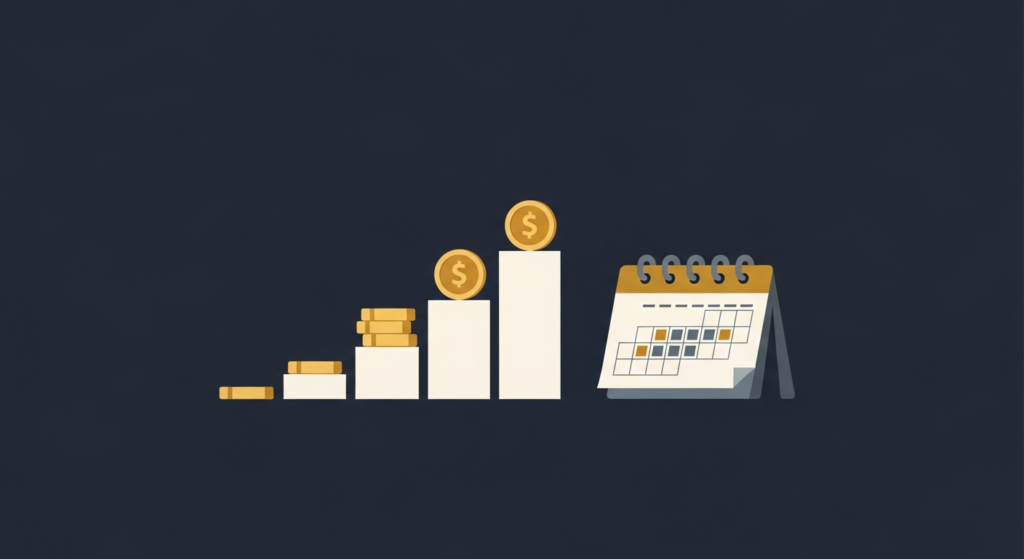
Phasing simply means breaking your target into installments spread across time. If your target is $8,000 and you buy $400 a month, you reach it in about twenty months — and your average purchase price reflects roughly twenty different snapshots of the market rather than one lucky or unlucky day.
There’s a real cost to weigh: premiums. Smaller, more frequent purchases often carry higher premiums over spot per ounce than one large order, and some dealers charge shipping per shipment. So very small, very frequent buys can quietly cost you more in fees than the timing benefit is worth. A sensible middle ground is buying in chunks large enough to keep premiums reasonable — for many people that means a quarterly purchase rather than a tiny weekly one. We cover what you’re really paying above the metal’s value in gold premiums over spot.
Fractional vs whole ounces: matching the format to your budget
How you buy depends a lot on how much you’re spending at a time. A single one-ounce gold coin runs into the low thousands of dollars at recent prices, which is fine if you’re deploying a few thousand at once but awkward if you’re buying $200 or $300 at a time.
That’s where fractional gold comes in — coins minted in 1/2, 1/4, 1/10, and even 1/20 ounce sizes, plus small bars and privately minted rounds. Fractional pieces let a modest monthly budget actually buy something, and they make selling easier later: you can liquidate one tenth-ounce coin to raise a little cash without breaking up a whole ounce. The catch is cost. Smaller pieces carry meaningfully higher premiums per ounce — you pay more above spot for a 1/10-oz coin than for a full ounce, because minting and dealer costs don’t shrink in proportion to the metal.
So the format follows the budget. Buying $300 a month? Fractional coins or rounds keep you invested without forcing you to save up for months between purchases — just accept the higher premium as the price of flexibility. Deploying $3,000 or more at a time? Whole one-ounce coins, or bars, lower your premium per ounce and are the more cost-efficient choice. Many people mix the two: whole ounces for the bulk of the position, a few fractional pieces for divisibility. We lay out the sizes, premiums, and trade-offs in fractional gold.
| Buying per purchase | Practical format | Premium trade-off |
|---|---|---|
| $100–$500 | Fractional coins, rounds, small bars | Higher premium per ounce; buys flexibility |
| $500–$2,500 | Mix of fractional and a whole ounce | Moderate; balances cost and divisibility |
| $2,500+ | Whole one-ounce coins or bars | Lower premium per ounce; most cost-efficient |
Rebalancing as the rest of your portfolio grows
Reaching your dollar target isn’t the end of the job, because the target itself moves. Your gold goal is a percentage of your portfolio, and the portfolio keeps changing. As your stocks and bonds grow — through contributions and market gains — your gold slice quietly shrinks as a share of the whole, even if you never sell an ounce. An $8,000 position that was 8% of a $100,000 portfolio becomes only about 5.3% once that portfolio grows to $150,000.
That’s not a problem to panic over, but it does mean the buying never fully stops if you want to hold your target. The cleanest way to stay on track is to direct new contributions toward whichever holding is underweight. If gold has drifted below target because your stocks ran up, your next few gold purchases nudge it back; if gold has surged past target, you pause buying (or trim) and let contributions flow elsewhere. Topping up the underweight asset with new money is gentler than selling, and it avoids triggering the collectibles tax — physical gold’s long-term gains are taxed up to 28%, higher than the rate on stocks. The portfolio-theory side of rebalancing lives in the allocation guide; here the takeaway is practical: revisit your percentages once a year, and aim new purchases at the gap.
A simple buying plan, start to finish
Put it together and the whole thing fits in a few steps. Fund your emergency savings and clear high-interest debt first. Settle your target percentage — read the allocation guide if you haven’t. Multiply your portfolio by that percentage to get a dollar target. Choose a pace you can sustain — a fixed amount monthly or quarterly — rather than one big buy. Match the format to each purchase: fractional when you’re spending a few hundred, whole ounces or bars when you’re spending a few thousand. Buy from reputable dealers, not auction sites. Then, once a year, check your percentages and aim new money at whatever has drifted below target. None of it is exotic. The discipline — small, steady, on a plan — is what separates a sensible gold position from an impulsive one. For where to buy and how the whole process fits together, start at the How to Buy Gold hub. This is general education, not personal advice; for a number tailored to your situation, talk to a fiduciary advisor.
Frequently asked questions
How much gold should I buy on a $100,000 portfolio?
If you’ve settled on a common 5–10% target, that’s $5,000 to $10,000 of gold on a $100,000 portfolio — about $8,000 at an 8% target. But the dollar figure is a destination, not a deadline. Most people are better off reaching it gradually with regular purchases than buying the full amount in one day, so timing risk and beginner mistakes stay small.
Should I buy all my gold at once or spread it out?
For most larger targets, spreading purchases out is the lower-stress choice. Buying everything on one day anchors your whole position to a single price, while phasing in across months smooths your average cost and lets you learn the mechanics on small stakes. A one-time purchase can make sense only if the dollar target is small and you have the cash without touching your emergency fund.
Should I buy fractional gold or whole ounces?
It depends on how much you’re spending per purchase. Fractional coins and rounds let a modest monthly budget buy something and make selling small amounts easier, but they carry higher premiums per ounce. Whole one-ounce coins and bars are more cost-efficient when you’re deploying a few thousand dollars at a time. Many people mix both — whole ounces for the bulk, fractional for flexibility.
What should I do before buying any gold at all?
Two things come first. Build an emergency fund of three to six months of expenses in accessible cash, since gold is volatile and costly to sell in a pinch. Then clear high-interest debt, because paying down a 22% card is a guaranteed return that beats gold’s slow growth. Funding tax-advantaged retirement accounts also generally comes before a non-income asset in a taxable account.