Dollar-Cost Averaging Into Gold

Straight answer
Dollar-cost averaging (DCA) means buying a fixed dollar amount of gold on a set schedule — say $300 a month — no matter what the price is doing. It works because gold pays no income and its short-term moves are nearly impossible to forecast, so a steady schedule spares you from guessing the bottom and smooths your average cost over time. It is not magic: if gold rises steadily, a lump sum would have beaten it. DCA’s real payoff is behavioral — it removes the fear and greed that wreck most timing attempts.
If you have decided gold belongs in your portfolio, the next question is how to put money in — all at once, or a little at a time. Dollar-cost averaging is the “little at a time” approach, and for most people buying a non-income asset whose price nobody can reliably predict, it is the calmer and more disciplined way to build a position.
What dollar-cost averaging actually is
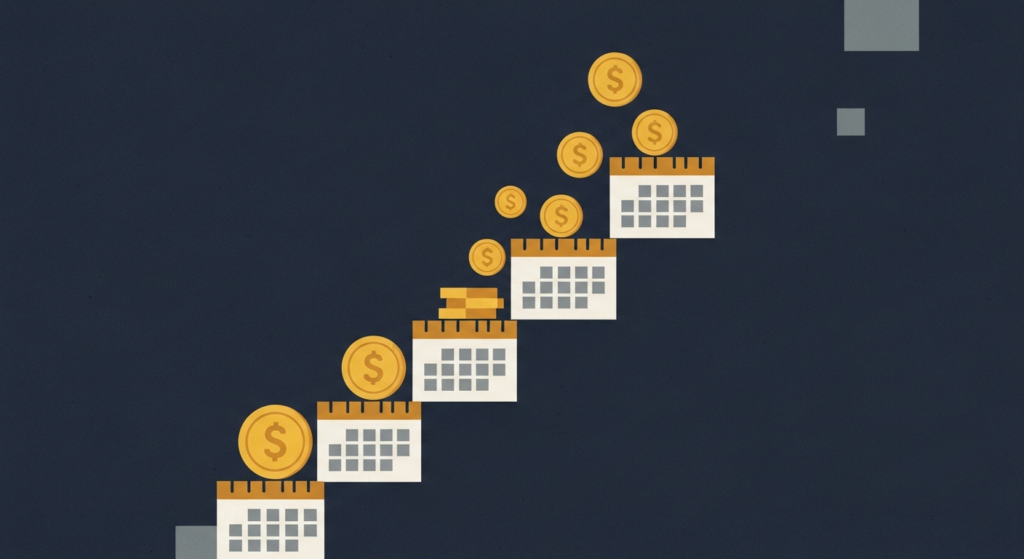
Dollar-cost averaging is a simple rule: invest the same dollar amount on a regular schedule, regardless of the current price. You decide the amount ($200, $500, whatever fits your budget) and the cadence (monthly or quarterly), then you keep buying through high prices and low prices alike.
The key word is dollar, not ounce. You are not buying a fixed number of ounces each time — you are spending a fixed number of dollars, and letting the price decide how many ounces (or grams, or shares) that buys. When gold is expensive, your fixed amount buys fewer ounces. When gold is cheap, the same amount buys more. That single mechanic is what does the work.
Why DCA beats trying to time gold
Timing means buying when you think the price is low and waiting when you think it is high. The problem is that gold gives you almost nothing to time with. A stock has earnings, cash flow, and a dividend you can value. Gold has none of that — it pays no interest, no dividend, and produces nothing. Its price is driven mostly by real interest rates, the strength of the US dollar, and investor fear, all of which are notoriously hard to forecast even for professionals who do it full-time.
So “buying the dip” in gold usually means guessing. And the cost of guessing wrong cuts both ways: sit in cash waiting for a pullback that never comes, and you watch the price run away from you; pile in at what feels like an obvious low, and you may simply be early. DCA sidesteps the whole question. You stop trying to predict the unforecastable and let the schedule decide. For a fuller look at whether the present moment is a good entry point at all, see is it smart to buy gold now — the honest answer there is part of why a schedule beats a hunch.
How DCA smooths your average cost
Because your fixed dollars buy more ounces when prices are low and fewer when prices are high, your purchases are automatically weighted toward the cheaper months. Over time that pulls your average cost per ounce below the simple average price across the same period. You are not beating the market — you are just refusing to overweight the expensive moments.
Here is a stylized example. Suppose you invest $300 a month and the gold price wobbles up and down. In the months where the price dips, that same $300 quietly buys more metal:
Notice the pattern: the bars are tallest exactly when the price is lowest. You did nothing clever — the fixed-dollar rule did it for you. Add up the ounces and divide by total dollars spent, and your blended cost lands below the average of the monthly prices. The more the price swings around, the more this effect helps; in a market that only ever rises in a straight line, it helps less (more on that below).
Setting up a DCA plan in practice
Pick a cadence. Monthly is the most common and keeps each purchase small and routine. Quarterly is fine too, especially if you are buying physical and want to reduce transaction friction. The exact frequency matters far less than actually sticking to it.
Pick a vehicle. There are two practical routes, and they have very different cost profiles for small, frequent buys:
Physical gold via periodic purchases
You can DCA into physical coins or bars by making a purchase each period from a reputable dealer. The catch is the premium over spot — the markup you pay above the metal value. On small orders that premium is proportionally larger, and you pay it every single time you buy. Dollar-cost averaging your spot price while overpaying on premium each month can quietly undo the benefit. The fix is to batch: let your monthly contributions accumulate in cash and buy a larger lot quarterly or twice a year, where premiums per ounce are lower and shipping is spread across more metal.
A gold ETF via auto-invest
For the DCA portion specifically, a low-cost gold ETF is often the cleaner tool. Brokerages let you schedule automatic recurring purchases, commissions are typically zero, and you avoid paying a physical premium on every small buy — you pay only a small annual expense ratio (funds like GLDM and IAUM run around 0.09–0.10%). Many investors run a hybrid: auto-invest into an ETF month to month for the discipline, then periodically convert a chunk into physical metal in a single larger, lower-premium order. To understand the trade-offs of paper versus metal more deeply, the premium math is covered under gold premiums over spot.
When a lump sum might be fine instead
DCA is a tool, not a commandment. There are reasonable cases where investing all at once is perfectly sensible:
- Your target gold position is small — if you only want $1,000 of gold total, spreading it over a year mostly adds friction (and, for physical, repeated premiums) for little benefit.
- You have a long horizon and the money is already sitting in cash. Historically, putting a lump sum to work tends to beat slow-walking it, because the asset spends more time invested. DCA gives up some of that expected return in exchange for lower regret.
- You are rebalancing a portfolio to a target allocation in one move rather than building a position from a paycheck.
The honest framing: lump sum usually wins on the math; DCA usually wins on the nerves. Deciding how big the position should be in the first place comes before either choice — work that out with how much gold to own.
The behavioral payoff
The strongest argument for DCA has little to do with average cost and everything to do with your own behavior. Markets punish emotion. Fear keeps people on the sidelines after a price drop — exactly when buying is cheapest. Greed pulls people in after a long run-up — exactly when they are paying the most. A fixed schedule overrides both. You buy through the scary months because the rule says to, and you are not tempted to chase a rally because your next purchase is already on the calendar.
That discipline is most of the value. A plan you stick with beats a clever plan you abandon at the worst moment. For where DCA fits within the broader question of buying gold at all, return to the how to buy gold hub.
Does dollar-cost averaging guarantee a lower price?
No. DCA tends to pull your average cost below the average price when the market swings up and down, because your fixed dollars buy more in the cheap months. In a market that rises steadily, a lump sum invested earlier would have done better. DCA’s reliable benefit is discipline and reduced regret, not a guaranteed discount.
Should I DCA into physical gold or a gold ETF?
For frequent small buys, an ETF on auto-invest is usually cleaner — no per-purchase premium and typically no commissions. If you want physical metal, batch your monthly contributions in cash and buy a larger lot quarterly or twice a year, where premiums per ounce are lower. Many investors do both: ETF for the recurring leg, physical in periodic larger orders.
How often should I buy?
Monthly is the most common cadence and keeps each purchase routine; quarterly works well if you are buying physical and want less transaction friction. The frequency matters far less than consistency — pick a schedule you will actually follow.
Is a lump sum ever better than DCA?
Yes. If your target gold position is small, your horizon is long, and the cash is already on hand, investing it all at once historically tends to beat spreading it out, because the money spends more time invested. DCA trades a bit of that expected return for lower timing risk and less emotional strain.