Is It Smart to Invest in Gold Right Now?

Straight answer
It depends on your goal and time horizon, not on the headline price. As a long-term hedge and diversifier, a small allocation can make sense in most market conditions. As a short-term bet, buying after a big run-up to record highs is risky, because gold pays no income and can correct sharply. The smart question is about your situation, not market timing.
“Is it smart to buy gold right now?” usually means “is the price about to keep rising?” That is the wrong question. A better one is: what are you trying to accomplish, and how long can you leave the money alone?
It depends on your timeline, not the price
The same gold price can be a reasonable buy for one person and a poor one for another, on the very same day. What separates them is time horizon and purpose.
If you are holding gold for years or decades as a hedge against inflation and currency risk, the exact entry price matters much less than your discipline over time. If you expect to need the cash within a year or two, gold becomes a short-term bet on price direction, and that is far harder to get right. As our full guide to whether gold is a good investment explains, gold’s job in a portfolio is diversification, not quick gains.
The case for buying now
There are honest reasons gold can earn a place in a portfolio at almost any time:
- Diversification. Gold often moves differently than stocks and bonds, so a small slice can smooth out a portfolio’s ups and downs.
- Inflation and currency hedge. Over long stretches, gold has tended to hold purchasing power when paper currencies weaken, though it does not track inflation month to month.
- No counterparty. Physical gold is not anyone’s promise to pay. It does not default.
None of these depend on catching a low. They are reasons to own some gold, not reasons to buy a large amount today.
The case for waiting, or at least caution
When gold sits at or near record highs, the case for caution gets stronger, especially for a lump-sum purchase:
- It pays no income. Gold produces no dividends, interest or rent. Its only return comes from selling it for more than you paid. While you wait, a savings account or bond may quietly pay you something.
- It can correct sharply. Gold has had multi-year stretches of flat or falling prices. Buying right after a steep run-up raises the risk of an uncomfortable drawdown.
- Prices set records often. A new high is not, by itself, a signal to buy or to sell. It tells you where the price has been, not where it is going.
The danger is buying out of excitement after headlines, then selling out of fear when the price dips. That pattern, not gold itself, is what usually loses money.
A smarter approach than timing: dollar-cost averaging
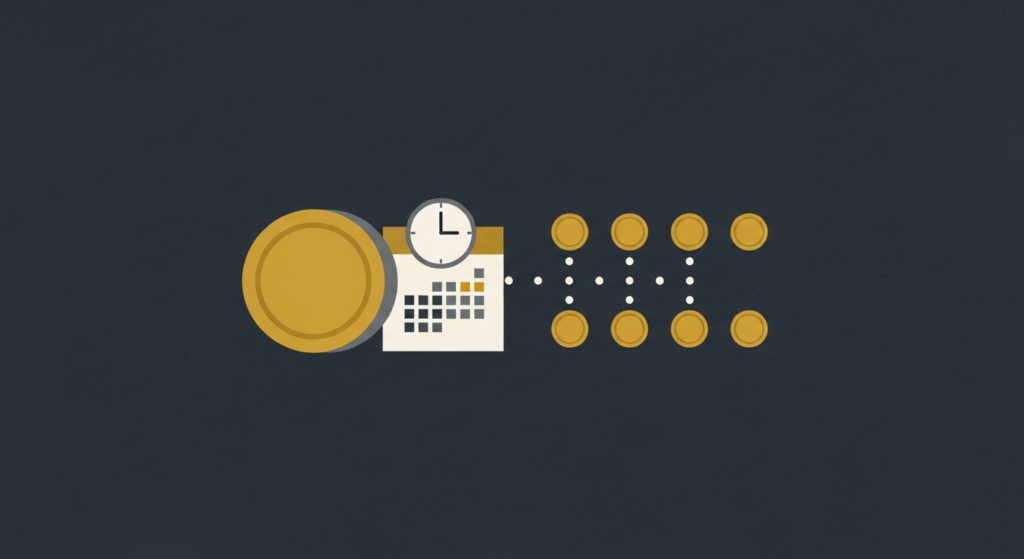
If you have decided gold belongs in your plan, you do not have to guess the perfect entry. Dollar-cost averaging means buying a fixed dollar amount on a regular schedule, say monthly or quarterly, regardless of the price that week.
When prices are high, your fixed amount buys a little less. When they fall, it buys a little more. Over time this averages out your cost and removes the pressure of timing a record-high market. It is a calmer, more repeatable approach than trying to call the top or the bottom.
How much is reasonable
For most people, a sensible cap on precious metals is roughly 5% to 10% of an overall portfolio. That is enough for gold to add meaningful diversification without betting your future on a single asset that pays no income.
Within that range, your own comfort matters. Someone close to retirement may want less in a volatile metal; someone with a long horizon and steady nerves might sit at the higher end. The point is that gold is a supporting role, not the lead.
Is gold a good buy at record-high prices?
It can be, for a long-term hedge bought gradually, but it is risky as a short-term bet. A record high tells you where the price has been, not where it is headed. If you are buying for the long run, dollar-cost averaging reduces the risk of putting a large sum in right before a correction.
Should I wait for gold to drop before buying?
Trying to wait for a dip often means missing the move entirely or buying in a panic later. If gold fits your plan, a steady schedule of small purchases tends to work better than waiting for a price that may never come. If you do not need an allocation, there is no obligation to buy at all.
How much of my money should be in gold?
A common guideline is about 5% to 10% of your total portfolio in precious metals. The right figure depends on your age, goals and risk tolerance. Holding far more concentrates your savings in an asset that produces no income.