Forms of Physical Silver: Coins, Bars, Rounds & Junk

Straight answer
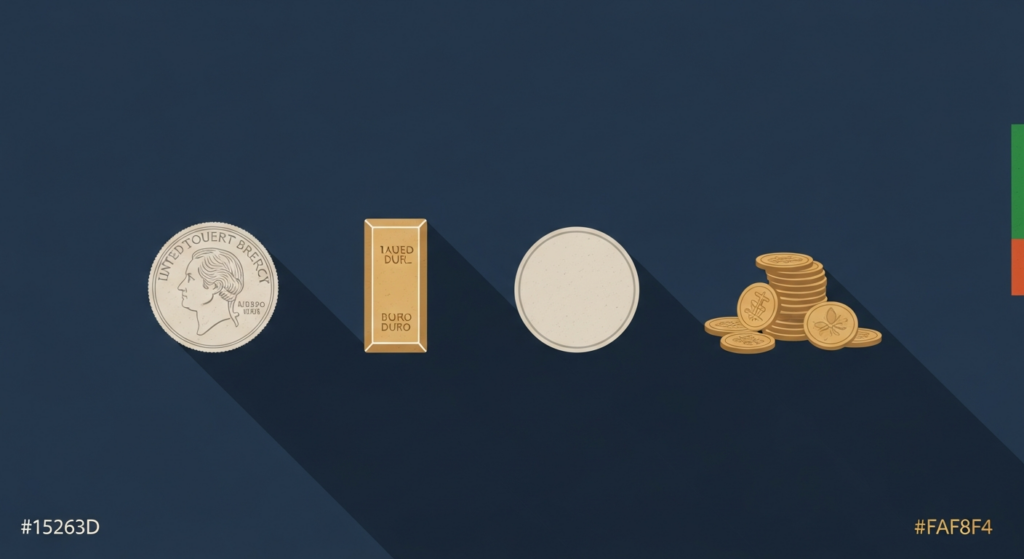
Physical silver comes in four main forms: sovereign coins (like the American Silver Eagle), bars, privately minted rounds, and junk silver (pre-1965 US coins). There’s no single best choice — it’s a trade-off between cost, liquidity, and divisibility. Coins cost the most per ounce but are the most recognized and easiest to resell; bars are the cheapest way to accumulate weight; rounds split the difference; and junk silver is the most divisible for small transactions.
The metal inside each of these is the same silver. What changes is the form factor — and the form factor decides how much you pay over the spot price, how easily you can sell, and how finely you can break up your holdings. Picking the right mix is less about purity and more about why you’re buying.
The four forms, and what actually separates them
Every form of physical silver is a claim on the same underlying metal. A one-ounce Silver Eagle and a one-ounce generic round contain nearly identical silver. The differences that matter to a buyer are three: premium (how far above the live spot price you pay), liquidity (how quickly and at what price you can sell), and divisibility (how small a piece you can transact). These three pull against each other. The most liquid, recognizable products tend to carry the highest premiums; the cheapest-per-ounce products are the least divisible. No form wins on all three, which is why most stackers end up owning a blend.
Sovereign coins: highest recognition, highest premium
Government-issued bullion coins are the gold standard of silver — the American Silver Eagle (.999 fine, minted by the US Mint and backed by a $1 face value), the Canadian Silver Maple Leaf (.9999), and the British Britannia are the headliners. Their appeal is trust. Because a national mint stamps the weight and purity, a dealer or private buyer almost never questions an Eagle. That recognition makes them the most liquid form of silver you can hold, and it’s why they command the highest premiums over spot — frequently in the double digits, and higher still when the Mint rations supply.
You pay for that liquidity twice: once on the way in (a fat premium) and partly on the way out (you sell below spot, though Eagles usually fetch the strongest buy-back bids). For most people buying smaller quantities, the premium is worth the peace of mind. For someone trying to convert a large sum into raw ounces, it’s an expensive habit. We break the lineup down further in silver coins explained.
Bars: lowest premium, best for weight
If your goal is simply to own the most silver for your dollar, bars win. They range from one ounce up to 100-ounce “monster” bars, and the premium per ounce drops as the bar gets bigger — a 100-oz bar is among the cheapest ways to buy physical silver, sometimes only a few percent over spot. The trade-off is divisibility and, to a degree, liquidity. A 100-oz bar is a single $3,000-plus object; you can’t shave off ten dollars of it to make a small purchase, and selling it means selling all of it at once.
Bars from well-known refiners (PAMP, Asahi, Sunshine Minting) resell easily; obscure or off-brand bars can draw extra scrutiny and sometimes an assay request. Larger poured bars are also the most counterfeited target, so buy from reputable sources. Bars suit the buyer accumulating weight as a long-term store of value who isn’t planning to transact in small pieces.
Rounds: the value middle ground
Rounds look like coins but aren’t. They’re privately minted discs of .999 silver with no government backing and no face value — just one ounce of metal stamped with whatever design the private mint chose. Because no sovereign mint is involved, premiums are low, often the cheapest per-ounce option after large bars, while keeping the convenient one-ounce, stackable, individually tradeable format.
The catch is recognition. A generic round isn’t quite as instantly trusted as an Eagle, so some private buyers discount it slightly and resale can be marginally slower. In practice, rounds from established mints trade easily. They’re a strong pick for the cost-conscious stacker who wants the handiness of coins without paying the sovereign premium. We cover bars and rounds together in silver bars and rounds.
Junk silver: built for divisibility and barter
“Junk silver” is an unflattering name for pre-1965 US dimes, quarters, and half-dollars, which are 90% silver. The “junk” just means they have no collector value beyond their metal — they’re worn circulated coins. They’re sold by face value, not by weight: a “$1 face” bag of dimes or quarters contains roughly 0.715 troy ounces of silver, and dealers quote junk silver as a multiple of face.
The standout feature is divisibility. A pre-1965 dime holds about a tenth of an ounce of silver — the smallest practical unit of physical silver most people will own. That makes junk silver the go-to for anyone thinking about small transactions or barter scenarios, since you can trade tiny, recognizable amounts. Premiums fluctuate with demand and can spike when small-denomination silver gets popular, landing it in the middle of the pack on cost. Worn coins also contain slightly less than their minted weight. The full picture is in junk silver explained.
Comparing the four side by side
| Form | Purity | Premium | Liquidity | Divisibility | Best for |
|---|---|---|---|---|---|
| Sovereign coins (Eagle, Maple) | .999–.9999 | Highest | Highest | Good (1 oz units) | Easy resale, smaller buys, no questions asked |
| Bars (1–100 oz) | .999 | Lowest | Good | Low (esp. large bars) | Accumulating weight cheaply |
| Rounds (private mint) | .999 | Low | Good | Good (1 oz units) | Cost-conscious stacking |
| Junk silver (pre-1965 US) | 90% | Middle | Good | Highest | Divisibility, small trades, barter |
How premium tracks with form
The single biggest cost difference between these forms is the premium over spot — the markup that pays for minting, distribution, and the dealer. Sovereign coins sit at the top, junk silver in the middle, rounds lower, and large bars at the bottom. The chart below shows the typical pattern. Note that silver premiums run higher than gold premiums as a percentage, because the dollar value per coin is small relative to the fixed cost of making it.
These are directional ranges, not quotes; premiums move with demand, mint capacity, and how much you buy at once. For the mechanics of why you pay above spot and sell below it, see silver premiums over spot — it’s a round-trip cost on every purchase.
Which form suits you
There’s no universal answer, but a few patterns hold. If you’re buying modest amounts and want the easiest possible resale, lean toward sovereign coins despite the premium. If you’re stacking weight as a long-term store of value and don’t expect to sell piecemeal, bars give you the most metal per dollar. Rounds are the sensible default for cost-conscious buyers who still want one-ounce units. And if your concern is being able to transact in small amounts — or you simply like the historical, recognizable nature of US silver coinage — junk silver is hard to beat.
Most experienced stackers don’t pick one. They hold large bars for the bulk of their weight, a stack of rounds or coins for liquid one-ounce trading units, and some junk silver for divisibility. The blend hedges the trade-offs instead of betting on one.
- Your only goal is maximum ounces per dollar — bars or rounds get you more metal.
- You’re buying a large quantity, where coin premiums add up fast.
- You’re chasing collectible or “limited mintage” versions — those carry numismatic markups unrelated to silver content.
- You haven’t yet decided how much silver fits your situation — this is general education, not advice.
Are silver rounds as good as coins?
In metal content, yes — a one-ounce .999 round and a one-ounce Silver Eagle contain nearly the same silver. The difference is recognition and premium. Government coins resell more easily and command higher markups; rounds cost less but may draw slightly more scrutiny from some buyers. For most people both are perfectly sound ways to own silver.
What is junk silver and how is it priced?
Junk silver is pre-1965 US dimes, quarters, and half-dollars, which are 90% silver and have no collector value beyond their metal. It’s sold by face value, not weight — roughly $1 face equals about 0.715 troy ounces. Its main advantage is divisibility for small transactions.
Which form of silver has the lowest premium?
Large bars, especially 100-ounce sizes, typically carry the lowest premium over spot. Rounds are next. Sovereign coins like the Silver Eagle carry the highest premiums because of mint costs and their strong recognition and liquidity.
Should I buy bars or coins?
It depends on your goal. Bars are cheaper per ounce and best for accumulating weight, but they’re hard to divide and sell only as a whole. Coins cost more but are the most liquid and recognizable. Many stackers own both.