What Is the Safest Asset in the World?

Straight answer
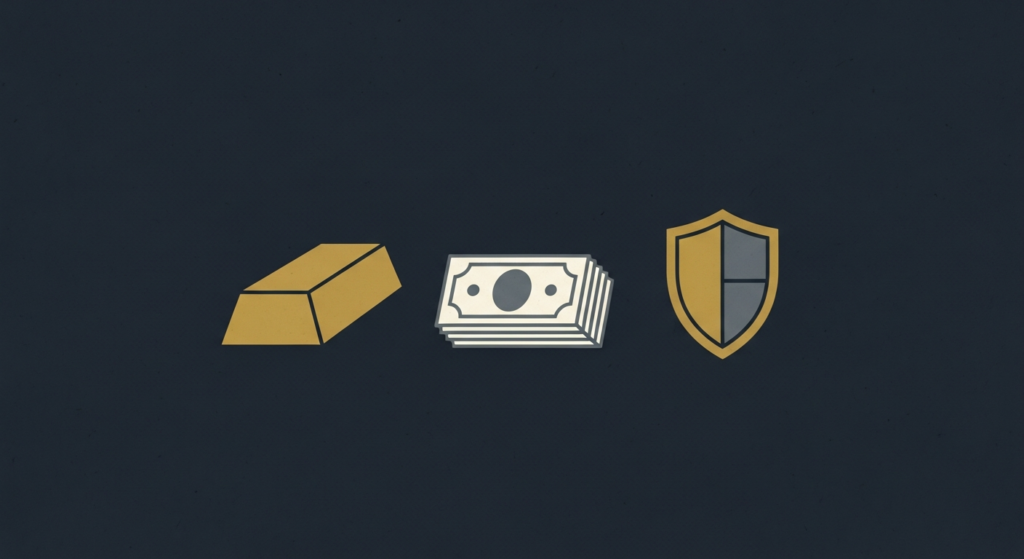
There is no single safest asset, because “safe” means different things depending on the risk you are guarding against. To protect a fixed amount of dollars over the short term, cash in FDIC-insured accounts and short-term US Treasuries are the benchmark. To preserve purchasing power against currency debasement over decades, physical gold is the classic store of value. No asset is safe on all three counts at once, so the honest answer is: it depends what you are afraid of losing.
People ask for the world’s safest asset hoping for one clean answer. The trouble is that safety splits into at least three different risks, and the asset that handles one often fails at another. Knowing which risk you are protecting against matters more than the label “safe.”
“Safe” splits into three different risks
Before naming any asset, separate what you mean by safe. Most confusion about safety comes from blurring these together:
- Safe from price swings. The dollar value barely moves day to day. You can sell tomorrow and get back roughly what you put in.
- Safe from inflation. The buying power holds up over years, even if currencies weaken and prices rise.
- Safe from systemic and counterparty risk. The asset does not depend on a bank, a government, or a company keeping its promise to pay you.
An asset can excel at one of these and fail badly at the others. That trade-off is the whole story, and it is why “what is the safest asset” has no universal answer.
Safe from price swings: cash and short-term Treasuries
If your worry is seeing your balance drop next month, the benchmarks are cash in a bank account and short-term US government debt.
A deposit in an FDIC-insured bank account is protected up to $250,000 per depositor, per insured bank, per ownership category. The dollar figure does not fall. Short-term US Treasuries (T-bills) are widely treated as the “risk-free” rate in finance because the US government has never defaulted on them, and short maturities barely move in price.
The catch is inflation. Cash and T-bills protect the number of dollars, not what those dollars can buy. In a high-inflation stretch, you can hold a perfectly “safe” account and still quietly lose purchasing power every year. Safe from price swings is not the same as safe from erosion.
Safe from inflation: physical gold
If your worry is that the dollar loses value over decades, the traditional answer is physical gold. It has been a store of value across centuries and currencies, and it is no one’s liability to pay. There is no company behind it that can go bankrupt and no government that can print more of it.
Gold’s long-run record as an inflation hedge is real but loose. It tends to hold purchasing power over long stretches rather than tracking the monthly inflation print. Its price is driven more by real interest rates, the strength of the US dollar, and investor fear than by any single CPI report. We cover this nuance in our guide on whether gold is an inflation hedge.
Here is the honest limit: gold is not safe from price swings. It can fall hard and stay down for years. It has had multi-year stretches of flat or sinking prices, and a 20% drawdown is well within its normal range. Calling gold a “safe haven” oversells it. It is safe in the sense of preserving long-run purchasing power and avoiding counterparty risk, not in the sense of a stable price you can count on next quarter.
Safe from systemic risk: assets with no counterparty
The third kind of safety is freedom from someone else’s promise. A bank deposit relies on the bank and on deposit insurance. A bond relies on the issuer paying you back. Even cash relies on confidence in the currency.
Physical gold and other tangible assets sit outside that chain. They do not default, because there is no counterparty to default. That is a genuine strength in a banking crisis or a sovereign debt scare. But the price you pay is volatility and cost: physical metal swings in value, carries dealer premiums when you buy and sell, and needs secure storage. You trade one risk for another, you do not erase risk.
Why no asset wins all three
Put the three risks side by side and the pattern is clear. Cash and T-bills are calm and liquid but lose ground to inflation and still rely on the system. Gold resists inflation and counterparty risk but lurches in price. Stocks tend to beat inflation over the long run yet can crash 30% to 50% in a bad year. Each asset is buying down one risk by accepting another.
That is why diversification, not a single perfect asset, is the usual answer. Most advisors suggest keeping precious metals to roughly 5% to 10% of a portfolio: enough to add a different kind of safety without betting your future on one volatile metal. For the broader picture of where gold fits and where it does not, see our guide to whether gold is a good investment. This is general education, not personal financial advice.
What is the safest asset in the world?
There is no single safest asset, because safety depends on the risk you are guarding against. For protecting a fixed amount of dollars short term, FDIC-insured cash and short-term US Treasuries are the benchmark. For preserving purchasing power over decades, physical gold is the classic store of value. No asset is safe against price swings, inflation, and systemic risk all at once.
Is gold the safest asset?
Gold is safe in two specific ways: it has historically preserved purchasing power over the long run, and it carries no counterparty risk because it is not a promise from any bank or government. It is not safe from price swings, though. Gold can fall sharply and stay down for years, so calling it a guaranteed safe haven oversells it.
Is cash safer than gold?
It depends on the time frame. Over the short term, FDIC-insured cash is far safer because its dollar value does not move. Over many years, cash steadily loses purchasing power to inflation, while gold has tended to hold value. One protects the number of dollars; the other protects what those dollars can buy.