How Much Gold Will $50,000 Buy?

Straight answer
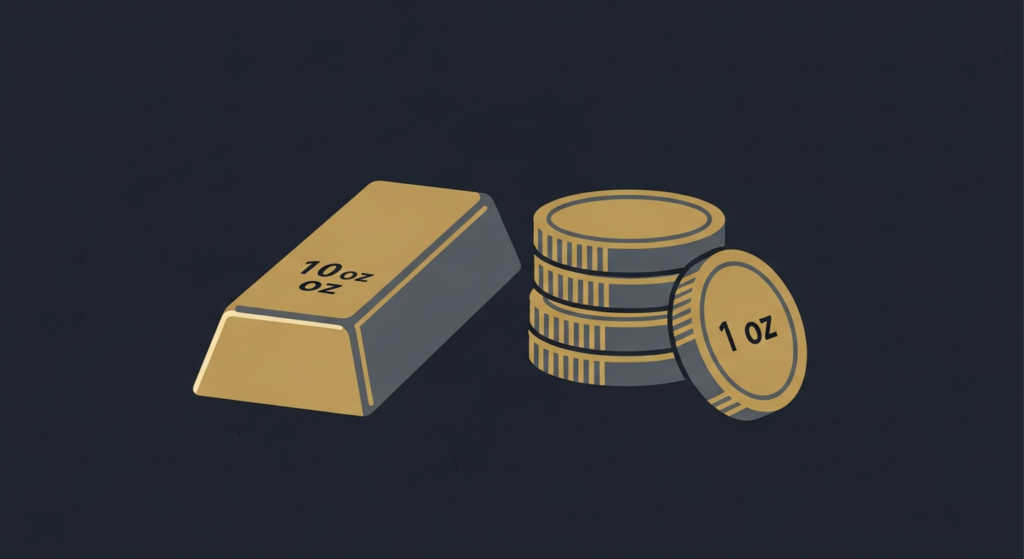
At an illustrative spot price of about $4,200 an ounce, $50,000 buys roughly 11.9 ounces of raw gold value. But you never pay spot — after dealer premiums you’ll realistically end up with about 11 to 11.5 ounces of physical metal. The smart move at this size is usually a mix: a few 1 oz coins for liquidity plus a 10 oz bar to drop your average premium. Exact figures depend on the day’s spot price and what you buy, so treat the numbers here as directional.
$50,000 is enough that the premium you pay starts to matter in real dollars, and enough that how you store and report it deserves a moment’s thought. Here’s the math, the product mix that keeps cost-per-ounce down, and the two practical loose ends — reporting and storage — that come with a purchase this size.
The spot math
Gold is priced per troy ounce, which is about 31.1 grams — slightly heavier than the ounce on your kitchen scale. The “spot” price is the live wholesale rate for raw metal. To see how far $50,000 goes, divide your budget by the spot price.
Using an illustrative spot of $4,200/oz: $50,000 ÷ $4,200 ≈ 11.9 troy ounces of pure gold value. That’s the theoretical ceiling — what you’d get if you could buy at the wholesale price with no markup. Nobody actually buys at spot, which is where premiums come in. (Spot moves constantly; at $4,000 the same budget buys 12.5 oz, at $4,500 it’s 11.1 oz, so check the live price before you plan around any single number.)
Premiums, and how bars lower your cost per ounce
Every retail purchase costs more than spot. That markup — the premium over spot — covers minting, distribution, and dealer margin. It’s the single biggest factor between “11.9 oz of value” and “ounces you actually take home.”
Premiums fall as the unit gets bigger and simpler. A 1 oz sovereign coin like an American Eagle carries the most polish and the highest markup. A 1 oz bar costs a bit less. A single 10 oz bar spreads the dealer’s fixed handling over ten ounces, so its percentage premium is the lowest of the three. That’s why, at $50,000, leaning on one larger bar meaningfully changes how much metal you walk away with — the difference between an ~5% blended premium and an ~8% one is roughly half an ounce of gold. See how gold bars work for the trade-offs that come with them.
| Form | Typical premium | Approx. oz for $50,000 |
|---|---|---|
| 1 oz sovereign coins (e.g. Eagle) | ~6–8% | ~11.0–11.2 oz |
| 1 oz bars/rounds | ~4–6% | ~11.2–11.4 oz |
| 10 oz bar | ~3–4% | ~11.4–11.6 oz |
| Blended mix (coins + one 10 oz bar) | ~5% | ~11.3 oz |
A sensible product mix at this size
The lowest-premium choice isn’t automatically the best one. A single 10 oz bar is cheap per ounce but hard to sell in part — if you ever need $8,000, you can’t shave a corner off it; you sell the whole thing. Coins solve that. A 1 oz coin is the most recognized, most liquid unit of gold on earth, and you can sell exactly as many as you need.
For most people at $50,000, a blend captures both benefits: roughly one 10 oz bar to hold down the average premium, plus a handful of 1 oz coins for divisibility and easy resale. That might look like a 10 oz bar plus one to two 1 oz coins, landing near 11.3 oz of metal. If liquidity matters more than squeezing out every dollar — say you might sell in pieces — weight toward coins. If this is buy-and-hold and you value cost efficiency, lean on the bar. Avoid the temptation to chase fractional or collectible coins here; their premiums climb fast and erode the advantage your budget gives you.
One reporting note before you pay
A purchase this size can cross a federal reporting line — but probably not the way people fear. If you pay a dealer more than $10,000 in cash (physical currency, or cash-equivalents like money orders) in one transaction or in linked transactions, the dealer must file an IRS Form 8300. This reports you, not a tax — it’s an anti-money-laundering rule, not a penalty, and buying gold is perfectly legal. A normal bank wire, check, or card payment is not “cash” for this purpose and doesn’t trigger the form. So a $50,000 wire raises no 8300 at all. The full picture, including dealer 1099-B rules when you sell, is in how much gold you can buy without reporting.
Storage at this value
Eleven-plus ounces is small enough to fit in your hand and valuable enough to insure. A home safe works if it’s quality, bolted down, and — critically — covered by an insurance rider, since standard homeowners policies cap precious-metals coverage low. A bank safe-deposit box is private and cheap but is not FDIC-insured, so insure the contents yourself. At $50,000 and up, many owners use an allocated third-party depository, where your specific metal is segregated, insured, and audited. Each option trades access against security and cost; storing gold safely walks through all three.
How many ounces of gold is $50,000?
At an illustrative spot price of about $4,200 an ounce, $50,000 equals roughly 11.9 ounces of raw gold value. Because you pay a dealer premium over spot, you’ll actually take home about 11 to 11.5 ounces of physical metal — the exact amount depends on the live spot price and whether you buy coins, bars, or a mix.
Is it cheaper to buy a 10 oz bar or ten 1 oz coins?
The 10 oz bar is cheaper per ounce, often by a few percentage points, because the dealer’s fixed costs spread across more metal. The trade-off is divisibility: you can’t sell part of a single bar, while 1 oz coins let you sell exactly as much as you need. At $50,000 a blend of one bar plus a few coins captures the lower premium and keeps liquidity.
Does buying $50,000 of gold get reported to the IRS?
Only if you pay with more than $10,000 in physical cash or cash-equivalents, which requires the dealer to file Form 8300 — an anti-money-laundering report, not a tax. Paying by bank wire, check, or card is not “cash” for this rule and triggers no filing. This is general information, not tax advice.